Relocating overseas with children used to mean a stark choice: enroll in a local school, pay steep fees at an international campus, or patch together homeschooling materials and hope for the best. That calculus has shifted. Today, the market for an American online school for kids abroad is crowded, competitive, and — on its better end — genuinely impressive. On its worse end, it is a minefield.
Diplomatic families, military households, corporate transferees, and parents who simply chose to raise their children in another country now have dozens of programs to consider. Some offer rigorous college-prep curricula, credentialed subject teachers, and diplomas that open doors at selective U.S. universities. Others issue credentials that a registrar or military recruiter will quietly set aside. Telling them apart is the whole game.
Accreditation: the credential behind the credential
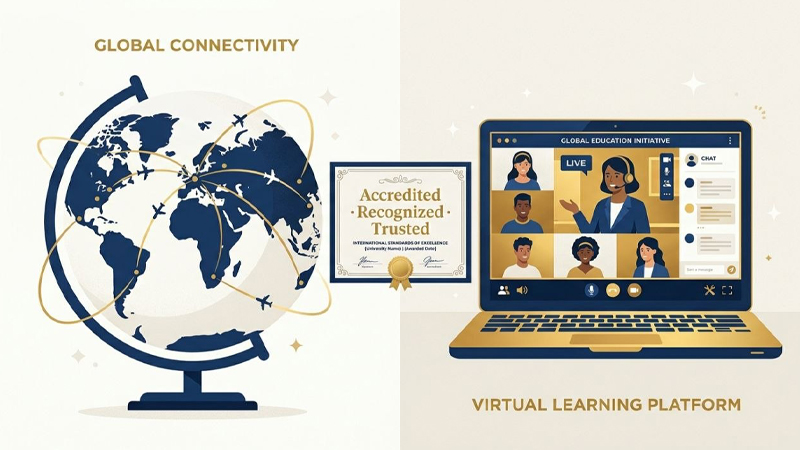
Ask ten expat parents what they checked before choosing an accredited American online school, and most will mention curriculum, price, and time-zone compatibility. Fewer will mention accreditation — and yet no other variable matters more when it comes to whether a diploma actually holds value years down the line.
Accreditation is not a sticker. It is a formal evaluation process conducted by an independent body that scrutinizes a school’s curriculum design, teacher qualifications, governance structure, and measurable student outcomes. In the United States, regional accreditation is the designation that carries real weight. The six regional bodies — Cognia (formerly AdvancED), the Middle States Association, the New England Association of Schools and Colleges, and their counterparts — evaluate online programs using the same standards applied to brick-and-mortar schools. A diploma from a regionally accredited institution travels well: universities recognize it, state transfer offices accept it, military academies count it.
National accreditation occupies a different tier. Historically associated with vocational and trade programs, it is accepted at many colleges but explicitly rejected by others — particularly selective institutions when evaluating transfer credit. Anyone comparing options for a US curriculum online school overseas should confirm not just that a school claims accreditation, but which body granted it, and whether that body appears in the U.S. Department of Education’s official database of recognized accreditors.
Ask this directly: “Is your accreditation regional or national, and can you provide a link to our school’s active listing on the accreditor’s own website?” A school that sends you to a third-party verification portal instead of the accreditor’s database is worth treating with serious skepticism.
There is a third category that rarely gets named in comparison guides: schools whose accreditation comes from bodies the Department of Education does not recognize at all. These organizations operate under professional-sounding names, maintain polished websites, and charge real money for credentials that are functionally worthless. Their diplomas will not satisfy college admissions offices, military recruiters, or many state licensing boards. This particular trap catches a disproportionate share of families seeking online education for expat children — partly because geographic distance makes independent verification harder, and partly because parents in a stressful relocation are primed to accept reassuring answers at face value.
State authorization: the other legal layer
A school can hold legitimate accreditation and still operate in a gray zone if it has no formal authorization from any U.S. state. Authorization matters because it creates accountability: an authorized program must meet that state’s graduation requirements, report student data to an oversight authority, and maintain records in a jurisdiction where they can actually be retrieved and verified.
Programs with no U.S. state footprint — operating entirely offshore, incorporated in jurisdictions with minimal educational oversight — may issue diplomas that are neither fraudulent nor recognized. They exist in an administrative no-man’s-land. This is a particular concern in the market for homeschool abroad American curriculum hybrids, where the line between a genuine school-family partnership and a commercial content vendor calling itself a school can be very thin indeed. One model produces an accountable academic record. The other produces materials and a certificate of completion.
Curriculum standards: what “American” actually means on a transcript
“American curriculum” is a marketing phrase, not a regulated standard. Any program anywhere can print it on a homepage. What a college admissions officer, a military academy evaluator, or a state transcript-review board actually looks at is whether a course of study maps onto recognized benchmarks — Common Core State Standards for core academics, the College Board’s AP framework for advanced work, or the International Baccalaureate continuum for internationally mobile families.
When evaluating any American online school for kids abroad, the question is not whether the school describes its curriculum as rigorous. The question is whether there is external evidence of that rigor: AP exam scores, IB results, published graduation requirements that match a verifiable state standard, and a transcript format that Common App and university registrars will recognize without needing a glossary.
What genuine rigor looks like in practice
- AP or IB courses that culminate in official external examinations — not internal assessments labeled as equivalent
- Named, credentialed teachers listed per subject on the school’s public website
- Syllabi available for review before any enrollment commitment is made
- Graduation requirements published in writing, mapped to a specific state’s standards
- A college placement record — not just anecdotes, but verifiable data on where graduates were admitted
Patterns that warrant a harder look
- No named instructors — marketing copy refers only to “a team of certified educators”
- Full-year courses completable in six weeks or less with no explanation of how mastery is assessed
- Grade distributions that look implausibly high without rubrics or external validation
- No option for proctored assessments — every evaluation is self-administered at home
- Transcripts on non-standard formats using narrative evaluations in place of letter grades
A specific note on AP courses online abroad: the College Board licenses AP course delivery to specific institutions. A school advertising AP courses must hold an active College Board contract — and students must sit for the actual College Board exams at an authorized test center, not an internal “AP-style” assessment. Any program offering “AP-aligned” or “AP-equivalent” courses without that contract cannot produce AP credit, regardless of how the transcript reads.
Teachers: the variable that actually drives learning
Well-designed online instruction can match classroom teaching. That sentence is supported by enough research to be settled. The operative word is “well-designed,” and good design starts with qualified people delivering the material.
In programs offering distance learning for American kids abroad, teacher quality is worth investigating directly. State licensure or subject-area certification matters — not as bureaucratic box-ticking, but as evidence that an instructor has demonstrated content knowledge in the specific discipline they teach. A biology course taught by someone with a biology certification is a different proposition from the same course delivered by a generalist with a broad “K–12 teaching credential.”
Student-to-teacher ratios tell a related story. A live class of eighteen students permits a teacher to respond to individual questions, adjust pacing, and notice when a student is lost. A recorded lecture sent to four hundred households does not. Families should also clarify what “live instruction” actually means in a given program: some schools use the phrase to describe pre-recorded video with a concurrent chat window. That is not live instruction in any meaningful sense.
For children in grades K–8, the availability of synchronous instruction is not a preference — it is a developmental necessity. Young learners need structured real-time interaction with adults outside their immediate family to build academic habits, practice sustained attention, and develop the feedback loop between effort and response. Older high school students with strong self-direction can thrive in asynchronous environments, but only when teachers respond to written work within reasonable timeframes and remain genuinely accessible.
Social development: the honest part of the conversation
Here is something that most program marketing will not say plainly: an American online school for kids abroad, regardless of its quality, does not replicate the full social experience of a traditional school. It cannot. Unstructured time with peers, navigating institutional group dynamics, developing sustained relationships with non-family adults in a daily setting — these are developmental experiences that virtual clubs and online discussion boards address only partially.
Acknowledging this is not an argument against online schooling. For most families living abroad, the alternatives are inaccessible, prohibitively expensive, or conducted in a language the child does not yet speak. The point is that online education for expat children works best when parents treat it as the academic engine of a larger childhood — one that is deliberately supplemented with local activities, sports, community involvement, or access to international school facilities through co-op arrangements.
Programs that accommodate this reality build flexibility into their schedules. A school that expects a child in Seoul or Nairobi to be academically available during U.S. business hours, with no provision for local afternoon activities, has designed its program around its own operational convenience, not around the child’s actual life.
Logistics: time zones, internet, and examination access
Operational details decide whether a program is genuinely usable or merely theoretically available. A family in East Asia, the Gulf, or sub-Saharan Africa faces a 6–13 hour differential from U.S. Eastern time. Live instruction scheduled for 9 a.m. EST lands at 10 p.m. in Bangkok. This is not a scheduling inconvenience — it is a structural incompatibility that no amount of enthusiasm overcomes after six months.
Before committing to any online diploma program for expats, the following deserve specific written confirmation from the school:
- Whether live sessions are offered across multiple time-zone windows, or whether the program is genuinely designed for asynchronous use with robust teacher-response commitments
- Whether course materials can be downloaded for offline use — a non-negotiable for families in areas with unreliable broadband
- Whether proctored examinations can be administered through testing centers in the family’s host country
- What the refund or credit policy looks like for a family required to relocate mid-semester — a scenario military and diplomatic families face with some regularity
Cost transparency: what the tuition page does not always show
Annual tuition in the market for the best online school for expat kids ranges from roughly $3,000 to over $20,000. Price correlates with quality less reliably than in most markets. A high-cost program is not automatically rigorous; a modestly priced one is not automatically weak.
What the tuition figure on a school’s homepage rarely includes: enrollment processing fees, technology platform fees, per-course materials costs, exam registration fees (AP exams alone run over $100 per subject), and transcript fees charged at graduation. Families who request a complete fee schedule in writing before enrollment avoid the unpleasant arithmetic of discovering these costs after a deposit has been paid. The willingness — or reluctance — to provide that schedule is itself informative.
Military, diplomatic, and missionary families: distinct considerations
Not every family choosing an American online school for kids abroad faces the same constraints, and three populations have needs that generic guidance tends to flatten.
Military families stationed at overseas installations should investigate Department of Defense Education Activity schools before pricing private alternatives. DoDEA schools are free, fully and regionally accredited, and staffed by teachers hired under federal employment standards. Their diplomas are recognized without question by every U.S. university and federal agency. At posts without a DoDEA school, the Department of Defense’s subsidized virtual school options are worth examining as a baseline before turning to the private market.
Diplomatic families at posts with an American School or a well-regarded international school face a genuine trade-off. The International Baccalaureate is accepted at the same level as AP coursework by virtually all U.S. universities, and an IB education delivered in a physical school with a genuine peer community may serve a child better than a U.S.-centric online program experienced in relative isolation — even if the latter carries a more familiar curriculum label.
Families in remote postings — mission work, NGO field assignments, research stations — typically need programs built for constrained infrastructure: downloadable content, minimal live requirements, multi-grade flexibility, and parent-supported delivery. Accreditation is not less important here; it is more so, because the family’s isolation makes it harder to catch and correct a bad enrollment decision before significant time has passed.
Twelve questions worth asking before you enroll
A school’s willingness to answer these questions directly — and the quality of those answers — reveals more than any marketing document.
- What is your regional accreditation body, and where does your current listing appear on that accreditor’s official website?
- In which U.S. state are you authorized to operate, and who is the designated oversight authority?
- Can I speak directly with the teacher assigned to my child’s core subjects before enrollment?
- What subject-area certification does that teacher hold, and in which state?
- What is your student-to-teacher ratio for live instruction?
- What percentage of last year’s graduating seniors enrolled in four-year colleges?
- Do your AP students sit for official College Board exams, and are you an authorized AP provider?
- How do you facilitate proctored exams for students in our specific country?
- Are live sessions available during reasonable hours for our time zone?
- Can I see a complete fee schedule — not just tuition — before signing an enrollment agreement?
- What is your refund and withdrawal policy for families who must relocate mid-year?
- Are there currently enrolled families in our region I could contact directly?
What the best and worst programs have in common — and where they diverge
The best accredited programs offering online education for expat children share a few consistent traits: their accreditation is verifiable in under three minutes, their teachers are named and credentialed, their college placement record exists and can be reviewed, and their operational design reflects an honest understanding of what it means to go to school from a different continent. These programs have produced graduates who attend selective universities, pass military academy admissions, and hold their own academically against peers who never left the United States.
The weakest programs share a different set of traits: vague accreditation claims, unnamed educators, implausibly short course completion timelines, and a marked reluctance to answer specific questions in writing. They are particularly adept at targeting families in the early, disorienting weeks of an overseas posting — when parental anxiety about continuity is highest and the capacity for careful due diligence is lowest.
Choosing the right American online school for kids abroad is genuinely achievable. The tools are straightforward: verify the accreditor, check the teacher credentials, request the full fee schedule, talk to a current enrolled family, and insist on a trial class before committing. None of this requires expertise. It requires only the discipline to ask before signing — not after the first transcript arrives at a college admissions office and the questions become significantly harder to answer.